
“I want to be a buyer, but I have no idea how to actually get a buyer job.”
If you’ve thought this (or said it to a friend), you’re not alone. At Style Nine to Five, we hear this from fashion grads, retail professionals, and even marketers who want to move closer to product.
Most people see Buyer or Assistant Buyer on a job posting and assume there’s one straight path: a buying degree and direct buying experience.
In reality, that’s not how most buyers get in.
As a fashion recruiter and founder of Style Nine to Five, Christie Lohr’s hired for buying roles across corporate head offices and resale/luxury consignment. After reviewing thousands of applications, the patterns are very clear: the people who get interviews aren’t always the ones with the most obvious backgrounds. They’re the ones who know how to position their experience.
Let’s walk through a simple way to think about getting into buying so you’re not just sending random applications and hoping.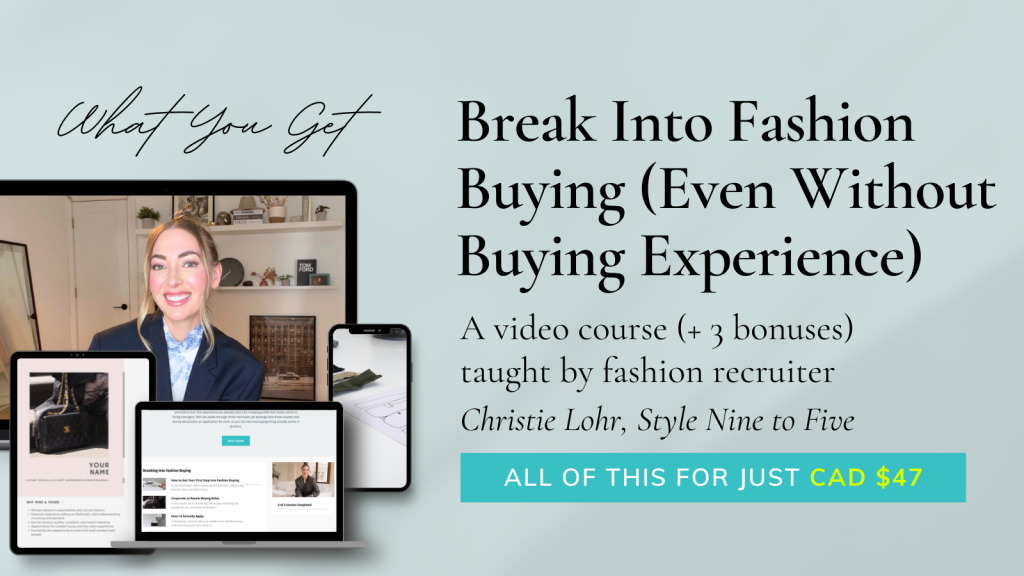
Step 1: Understand what a buyer actually does
“Buyer” sounds glamorous, but the day-to-day is a mix of:
• Looking at sales reports
• Planning future buys
• Working with vendors
• Watching sell-through and margins
• Understanding the customer
In a corporate head office buying role, you’re looking at numbers and trends, planning assortments, and working with planning, merchandising, and vendors.
In a resale or luxury consignment buying role, you’re looking at product and people — authenticating items, pricing, deciding what to take, and building relationships with clients.
Different environments, but the same core idea:
You’re deciding what to bring in, why it makes sense for that customer, and how it will sell.
If you’re serious about buying, start paying attention to both sides:
• The numbers (what’s selling)
• The customer (who’s buying and why)
Step 2: See where you already are on the map
Most people are closer to a buying path than they think.
Common entry routes we see for buyers:
Retail floor roles (key holder, supervisor, assistant manager)
You see what sells, what doesn’t, what customers ask for, and where the gaps are.
Wholesale or showroom roles
You see how brands sell to retailers, how orders are written, and how relationships work.
Visual merchandising or styling
You see how placement and product storytelling move product.
Fashion buying or merchandising programs
You have theory and projects and need to connect that to real experience.
All of these can become part of a buying story if you frame them properly.
Ask yourself:
• What have I done that shows I understand product?
• What have I done that shows I understand the customer?
• What have I done that touches sales, inventory, or performance?
Those are things buyers use every day.
Step 3: Decide which buying track fits you (corporate vs resale)
This is where many people get stuck. They apply to anything with “buyer” in the title.
You’ll move faster if you’re more targeted.
Corporate head office buying might fit you if:
• You’re comfortable with numbers and Excel
• You like planning and strategy
• You want to work on assortments and vendors behind the scenes
Here, brands care a lot about:
• Numbers
• Category experience
• Your understanding of their customer and aesthetic
Resale or luxury consignment buying might fit you if:
• You love luxury brands and follow them closely
• You enjoy talking to clients
• You’re interested in resale, sustainability, and second-hand fashion
Here, brands care a lot about:
• Luxury retail experience
• Brand knowledge
• Product judgment and trust
You don’t have to pick your forever path today, but knowing which direction you’re leaning helps you aim your resume, LinkedIn, and applications more effectively.
Step 4: Make your current role look like a stepping stone, not a detour
This is where many applications fall apart.
Candidates write their resume like a list of tasks instead of a story that shows why they’re ready for buying.
If you’re in retail, that might mean:
• Highlighting how you used sales reports or KPIs
• Talking about categories you helped grow
• Sharing examples where you noticed trends or customer feedback
If you’re in wholesale or a showroom, that might mean:
• Highlighting brands and product types you’ve worked with
• Mentioning how you supported order writing
• Showing you understand retailer needs
If you’re in visual merchandising or styling, that might mean:
• Showing how your work impacted sell-through
• Connecting your eye to results, not just aesthetics
The same job can look very different depending on what you choose to highlight.
Step 5: Show how you think, not just what you’ve done
This is the part almost no one does.
Most buying applicants just attach a resume, paste a generic cover letter, and hit apply.
If you want to stand out, you can go one step further and include a simple buying mini-project that shows how you think about product and customers.
You don’t need a beautiful presentation. You need to show:
• You understand the brand
• You understand their customer
• You can think like a buyer
This is often what gets attention at the application stage.
Where to go deeper (and get structured help)
You can absolutely start with this:
• Learn what buyers actually do
• See where your current role fits
• Decide which track makes sense
• Start rewriting your resume
• Think about how to demonstrate buying thinking
If you want a more structured way to do this instead of figuring it out alone, this is exactly what founder Christie Lohr teaches inside our course, How to Break Into Fashion Buying.
This is based on what our founder, Christie Lohr see every week reviewing buying applications and hiring for fashion brands.
Inside the course, she walks through:
• Realistic entry paths into buying
• The difference between corporate and resale buyer roles
• What brands actually look for when deciding who to interview
• How she reads and applies to real postings from companies
• How to turn your experience into an interview-ready buying profile
• How to create a simple buying mini-project you can actually use
If you’re thinking, “I know I want to be a buyer, but no one calls me back,” this was built for you.
👉 Learn more about the course here: https://styleninetofive.mykajabi.com/How-to-Break-Into-Fashion-Buying-Even-Without-Buying-Experience